

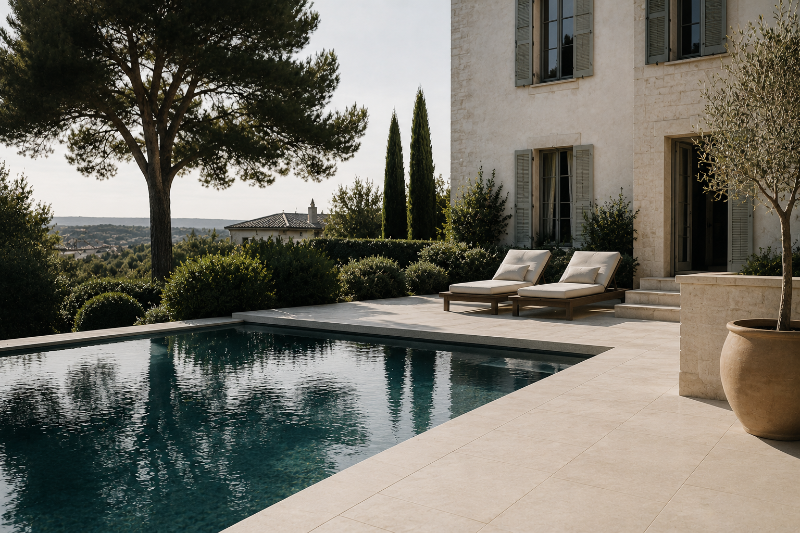
A villa acquired ten years ago in French countryside, held through a family SCI. A pool built the following summer, on the architect's advice. No tax declaration was filed - the notaire had not mentioned it, nor had the accountant. On the occasion of a sale, the DGFiP flags a discrepancy between the declared rental value and the actual state of the property. It may correct the omission without any limitation period. The pool has not disappeared - and neither have the satellite images from the Foncier Innovant project.
The taxation of private pools is a subject most property owners discover too late - at the point of sale, during a tax audit, or in the context of an estate. The stakes are real, particularly for owners of secondary residences, SCI-held properties, seasonal rental investors, and non-resident taxpayers with assets in France.
Yes - as soon as it required excavation work. The Conseil d'État has confirmed that a semi-buried pool constitutes a built property within the meaning of articles 1380 and 1381 of the French Tax Code (CGI), including a kit-form pool installed in the ground. The DGFiP treats it as a built amenity feature, which increases the rental value used as the basis for property tax (taxe foncière).
The annual increase varies by municipality and pool surface area. For a prestige property, it is not negligible - and it applies every year, without cap.
This is where the situation becomes more complex. For a primary residence, the pool only affects the taxe foncière. For a secondary residence, it also increases the secondary residence tax (THRS), which shares the same tax base. In high-demand areas, the municipality may additionally apply a surcharge of up to 60% on its share of the tax under article 1407 ter of the CGI.
For non-resident taxpayers who own a secondary residence in France, this impact is direct - and cannot be offset by the tax regime of their country of residence.
Article 1383 of the CGI provides for a temporary property tax exemption for additions to existing structures, of which pools form part. This exemption requires strict compliance with a filing deadline for notifying the tax authority after completion of the works. A late filing mechanically reduces the duration of the exemption - the Conseil d'État applies this deadline strictly, with no possibility of retrospective regularisation (CE, 19 July 2016, n° 373090).
There is also a timing lever related to the calendar year which can, depending on circumstances, represent a full year of savings. Using it requires anticipation before works begin.
Yes, a substantial one. A genuinely above-ground pool - placed without anchoring, without excavation, easily dismantled - does not affect the cadastral rental value and escapes both the taxe foncière and the THRS. Between this case and the clearly taxable masonry in-ground pool, there is a spectrum of intermediate situations whose classification is assessed on the facts according to criteria set by the Conseil d'État.
The choice of installation type is therefore not simply a matter of comfort or budget. The tax consequences of each option are worth examining before committing.
This is one of the most significant issues for owners of secondary residences. Article 150 VB of the CGI allows the acquisition price to be increased by construction, reconstruction, extension, or improvement costs incurred through a contractor - the pool qualifies provided it constitutes a new comfort feature.
This upward adjustment reduces the taxable capital gain on sale accordingly. It requires retaining contractor invoices - materials purchased directly by the owner are excluded under consistent case law. The composition of the original quote therefore has a direct bearing on future tax optimisation.
For non-residents, whose sale of French property is not exempt as a primary residence, this adjustment to the acquisition price carries particular importance, subject to the applicable tax treaty.
For properties held through an SCI, the allocation of construction costs to the acquisition price is assessed at company level - which requires rigorous accounting documentation from the time the works are carried out.
Under the BIC régime réel - applicable to non-professional furnished rental operators (LMNP) - the pool is depreciable over its accounting useful life. Its cost reduces taxable income each year, while significantly increasing achievable rental income during peak season. The outcome can be doubly favourable - provided the overall tax structure of the property is consistent with this régime from the point of acquisition.
Very real, and growing. Since 2022, the DGFiP has been deploying the Foncier Innovant project, an automated aerial image analysis system using IGN mapping data. Rolled out nationwide in 2023, it has identified over 140,000 undeclared pools to date. Failure to declare exposes the owner to a tax reassessment on taxe foncière and THRS with no limitation period under article L. 175 of the LPF, together with surcharges of up to 40% for deliberate default and 80% for fraudulent conduct under article 1729 of the CGI.
The tax questions surrounding a pool arise before the works begin - not after. The choice of installation type, construction timing, the composition of the contractor's quote, and filing within the legal deadline all have direct tax consequences - particularly for secondary residences, SCI-held properties, and rental investments.
Lobe Law, a specialist tax law firm based in Paris, advises property owners and investors on the optimisation and management of their real estate tax position in France. Book a consultation.