

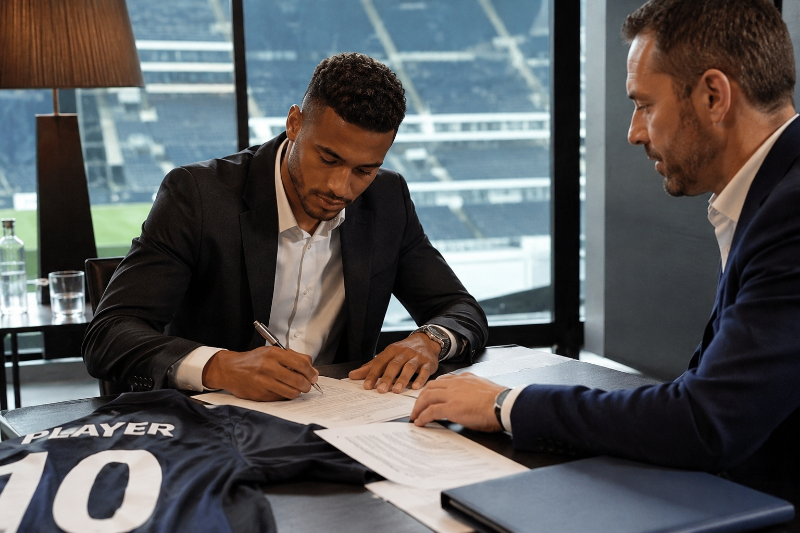
Image rights represent a growing share of professional athletes' income. Sponsorship deals, brand partnerships, name and shirt number licensing: these revenue streams are subject to specific tax rules in France, distinct from sports salary. Poorly structured, they can generate a very heavy tax burden. Properly anticipated, they represent a significant lever.
Image rights refer to the right of any person to control the commercial use of their image, name, voice, or any other attribute of their personality.
For a professional athlete, these rights can be exploited in several ways:
Each revenue stream has a distinct legal and tax nature. The characterisation retained directly determines the level of taxation in France - and the risk of reclassification by the DGFiP.
Without appropriate structuring, image rights income received personally is subject in France to income tax - with a top marginal rate of 45% - plus social levies and, for the highest earners, the exceptional contribution on high income (CEHR) at a marginal rate of 4%.
Since the French Social Security Financing Act for 2026, the total rate of social levies on the capital income concerned - dividends, capital gains on securities, royalties - has been raised to 18.6% in France. Certain income streams remain subject to the 17.2% rate (rental income, life insurance, housing savings plans in particular).
Depending on the characterisation retained, the total tax burden in France can therefore exceed 60% of the amounts received - before any structuring.
The characterisation of income - salary, non-commercial income (BNC), royalty, dividend - is not neutral. It determines the applicable tax regime in France and can vary depending on whether the contract is entered into directly by the athlete or through the club.
Housing image rights in a dedicated entity is a commonly discussed approach. It can indeed offer tax advantages in France - under strict conditions. Corporate income tax, with a standard rate of 25% in France, is significantly lower than the combined income tax and social levies applicable at a personal level. The gap can be substantial - but the structure must be robust to withstand scrutiny.
The DGFiP actively audits this type of arrangement. A company with no real substance, no genuine activity, and no documented governance is exposed to a full challenge under the anti-abuse provisions of the Tax Procedure Code. The expected tax saving can then turn into a tax reassessment with penalties.
Whether this structuring is appropriate depends on the athlete's personal situation, tax residence, the nature of the contracts involved, and the volume of income concerned. There is no standard template.
French sports law specifically governs, under article L. 222-2-10-1 of the French Sports Code, the commercial image exploitation contract concluded between a professional athlete and their club. This derogatory mechanism - which allows the royalty paid to the athlete to fall outside the salary framework under certain conditions - requires strict compliance with requirements relating to the drafting of the contract, the calculation of the royalty, and the caps set by collective bargaining agreement.
A poorly drafted or inadequately documented contract may be reclassified as salary by the DGFiP or by the URSSAF, with the resulting social and tax consequences. Prior legal analysis is essential.
The situation becomes more complex when the professional athlete performs in several countries or receives income from sponsors established abroad.
International tax treaties concluded by France provide rules for allocating taxing rights - but their application to image rights is far from automatic. The athlete's tax residence, the exact nature of the income, and the country of source are all parameters that affect the final tax position in France.
Structuring image rights cannot be improvised at the time of signing a sponsorship contract or a licensing agreement. It must be thought through upstream, from the negotiation stage, to be both effective and tax-secure in France.
Lobe Law, a law firm specialising in the taxation of professional athletes in Paris, advises players and their agents at every stage - from analysing the situation to implementing the appropriate structures. Contact us.