

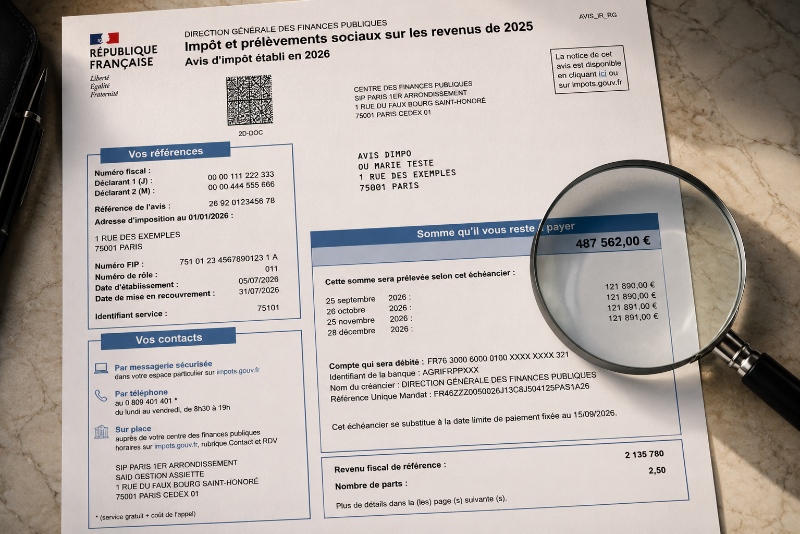
A taxpayer receives their tax assessment notice (avis d'impôt). The amount is higher than expected: income has been recorded twice, or an allowance has been left out. They assume the tax is settled, that the figure is the authorities' figure, and that nothing can be done. They pay. Eighteen months later, an adviser tells them the error was real, that the time limit to file a claim had not yet expired, and that they could even have avoided paying while the matter was discussed. The file was not lost. It was simply never opened.
Receiving a tax assessment notice does not extinguish the right to dispute it. The notice makes the tax due, but it also opens a contestation phase governed by its own rules of time and form. Those rules are short, and they are unforgiving. The real question is not whether the tax can be challenged, but for how long it remains open to challenge, and on what conditions.
A tax assessment notice is not final: a notice relating to income tax, to the wealth tax on real estate (impôt sur la fortune immobilière, IFI) or to local property tax can be challenged by a claim addressed to the French tax authorities, within a defined time limit. The notice makes the tax due; it does not place it beyond challenge. Once the claim period has passed, however, it does.
The most common error of reasoning is to treat the notice as a verdict. It is not. A taxpayer who considers that the tax charged to them is wrong, in fact or in law, has a right to file a claim. That right exists whether the error originates with the French tax authorities or with the taxpayer themselves: income declared twice, a tax reduction left out, an overstated IFI base are all challenged through the same procedure.
Challenging a tax assessment notice first requires a written claim (réclamation préalable) to the French tax authorities: this is a mandatory step before any application to the tax court, laid down by articles L. 190 and R* 190-1 of the Book of Tax Procedures (Livre des procédures fiscales, LPF). An application brought before the court without this prior claim is inadmissible, whatever the merits of the argument.
This claim is not an informal letter of protest. It must identify the tax at issue, set out the grounds relied on, be signed and enclose the contested notice. It also fixes the scope of the dispute to come. The taxpayer will not be able to bring before the court any tax they did not identify, nor claim more than they asked of the French tax authorities. The legal arguments, by contrast, remain open: a ground absent from the claim may still be raised later before the court. The legal basis can be made good later; the amount claimed cannot. This is why a claim is not drafted on the day one decides to contest, but on the day the analysis of the file is complete.
The time limit to challenge a tax assessment notice expires, as a general rule, on 31 December of the second year following the year in which the tax roll was issued or the notice served, under article R* 196-1 of the Book of Tax Procedures. But this general limit is not the only one: special limits, often shorter, apply to certain taxes. Identifying the one that governs the notice received is the first task, before any discussion of the merits.
This period looks comfortable. It rarely is as comfortable as it looks. The Book of Tax Procedures also provides for longer limits where the tax follows an audit. A taxpayer who believes they are within time may be caught by a shorter limit than the general one; another who believes they are time-barred may still have an open period. These are limitation periods: in principle neither interrupted nor suspended. That is the point most often overlooked, and the most costly.
Challenging a tax assessment notice does not suspend payment: the claim, on its own, does not suspend the tax's enforceability, and the public accountant (comptable public) may continue recovery while the claim is under review. To prevent this, the taxpayer must expressly request the stay of payment (sursis de paiement) provided by article L. 277 of the Book of Tax Procedures, within the claim itself. A claim silent on this point opens no stay.
The request for a stay follows strict formal rules. Where it is properly made, enforceability is suspended until the decision. Above a certain amount of contested tax - 4,500 euros under article R. 277-7 of the Book of Tax Procedures - the public accountant invites the taxpayer to provide guarantees, whose nature, cost and negotiation are themselves a financial matter. If the taxpayer succeeds, the costs incurred for those guarantees are refunded under article L. 208 of the same book. To forgo the stay for fear of this formality is to accept paying out a sum believed to be undue, sometimes for several years.
After a claim against a tax assessment notice is filed, the French tax authorities have six months to decide, under article R* 198-10 of the Book of Tax Procedures. Their silence during that period does not amount to acceptance: it merely opens the option of applying to the tax court, without setting any limitation period running against the taxpayer. An express rejection, by contrast, closes the deadline.
This silence places the taxpayer before a choice that is never neutral. Applying to the court at once fixes the debate on a file the French tax authorities have not yet reasoned; waiting allows late-payment interest to accrue if the dispute is ultimately lost. Where there is an express rejection, the action must be brought before the court within two months of notification of that rejection, provided the notification properly states the avenues and time limits for appeal. And the right court must be chosen. The dispute is divided between the administrative court (tribunal administratif), competent for income tax, corporation tax and value added tax, and the judicial court (tribunal judiciaire), competent for the IFI and registration duties. An error as to which court has jurisdiction costs time, and sometimes the deadline itself.
A challenge to a tax assessment notice is almost never lost on the merits. It is lost through a deadline left to run, a stay forgotten, a claim pitched too low, a court wrongly chosen. None of these errors is visible at the moment it is made. All of them are final once the time limit has passed.
The taxpayer in the opening scenario was not wrong on the merits. They had allowed the only window in which the merits could still be examined to close, without knowing it.
Lobe Law, a tax law practice in Paris, reviews your tax assessment notice, secures the deadlines and represents you through to the resolution of the dispute. Book a consultation.